

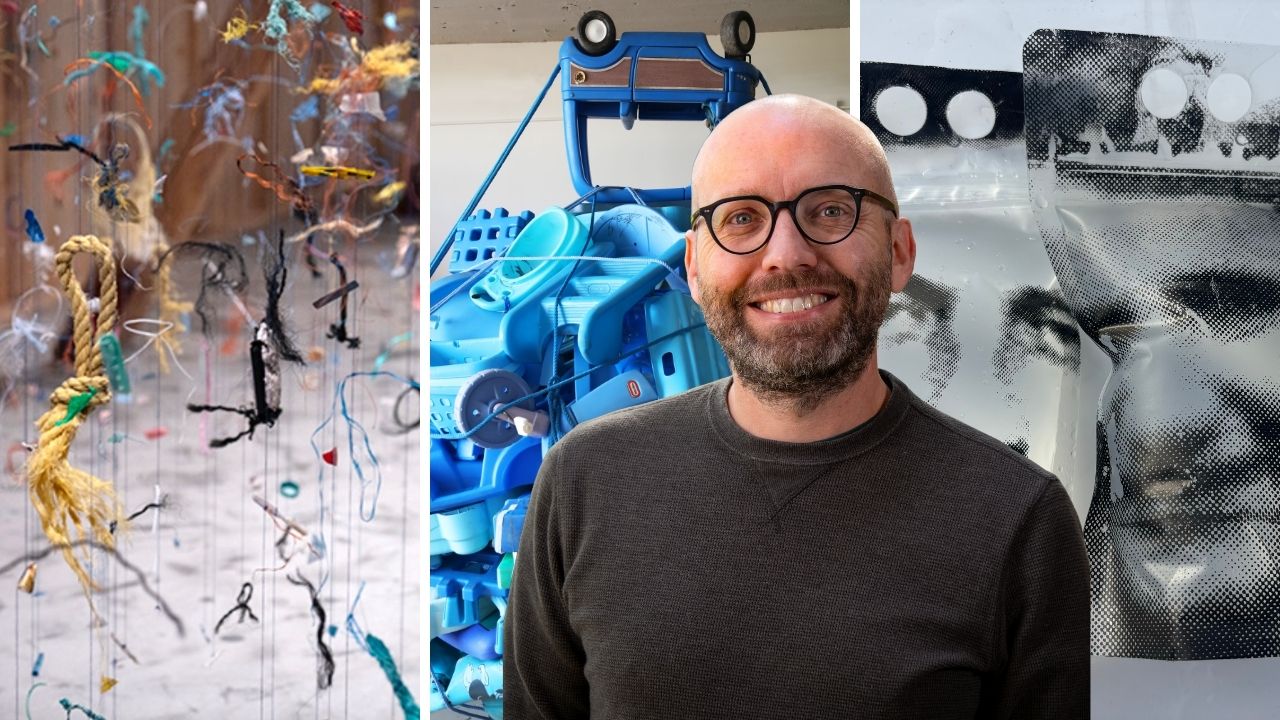
A Conversation with Douglas Tewksbury, Ph.D. Guest Curator, Human/Nature: Envisioning the Environment
On View: February 26, 2026–January 3, 2027
In Human/Nature: Envisioning the Environment, guest curator Douglas Tewksbury, Ph.D., brings together seven artists whose works explore the layered, urgent, and deeply human dimensions of climate and ecology. Rooted in the Environmental Humanities, the exhibition asks not simply what nature is—but what it means. We spoke with Tewksbury about complexity, collaboration, and the power of art to help us navigate a changing world.
Castellani Art Museum: The exhibition begins with the idea that to speak of “nature” today is to engage with memory, myth, urgency, and crisis. What sparked Human/Nature?
Douglas Tewksbury: We often talk about nature as though it’s singular or stable. But how we understand the natural world is shaped by politics, culture, economics, and media. The Environmental Humanities ask: What does nature mean? What does the climate crisis mean? Each artist in this exhibition wrestles with those questions individually—and collectively, their works create an ongoing conversation about those layered meanings.
CAM: The title plays on duality—“Human/Nature” as both a division and an entanglement. How does that shape the exhibition?
DT: Here in Niagara Falls, we live in that entanglement. We’re surrounded by extraordinary beauty—the Falls, the Great Lakes—while also carrying a legacy of environmental damage and industrial waste. That tension reflects the broader human condition. The exhibition doesn’t try to resolve that complexity; it invites viewers to sit with it.
CAM: You’ve brought together artists from Niagara Falls, New York City, Texas, British Columbia, Ontario, and Florida. Why this group?
DT: Simply put: the work. Chantal Calato, Jeri Coppola, Simon Frank, Beili Liu, Alison Shields, Eszter Sziksz, and Dana Murray Tyrrell each bring ambitious scale and distinct vision.
Many engage water—perhaps unsurprisingly, given our location on the Niagara River and within the Great Lakes region. I trusted each artist to interpret environmental concerns in their own way, and that autonomy created powerful dialogues across CAM’s central gallery.
CAM: The works span installation, painting, sculpture, photography, and print. What does that range of media allow?
DT: It allows environmental issues to become physical and immediate. Eszter Sziksz’s water-filled prints change over time. Simon Frank hammers the imprint of a forest into plywood. Chantal Calato transforms discarded plastic toys into monumental forms. These approaches make abstract concerns tangible—something viewers can see, feel, and confront directly.
CAM: The exhibition emphasizes that environmental art is not just about crisis, but about reimagining our relationship with the living world. How do the works expand that relationship?
DT: We often conceptualize nature as something separate from us—something to use or extract from. These artists challenge that illusion. Their works remind us that we are embedded within ecological systems. It’s a reciprocal relationship, and that realization carries both responsibility and possibility.
CAM: The exhibition extends beyond the gallery through NU Theatre productions and a conversation with neuroscientist Clayton Page Aldern. Why was that interdisciplinary expansion important?
DT: From the beginning, this project was meant to spark dialogue across campus. Theatre, scholarship, neuroscience—these are different languages engaging the same questions. Aldern’s work, in particular, explores how climate change reshapes our brains and bodies. Like the artists in this exhibition, he helps translate complex science into human experience.
CAM: As visitors leave the gallery, what question do you hope stays with them?
DT: At Niagara University, we often reflect on Vincentian questions of social justice: What can be done? What should be done? What must be done? I hope these works help each visitor begin forming their own response—an answer that continues to unfold long after they leave the gallery.